

It seems that all investment structures are being attacked by Government and Revenue Authorities these days. SMSFs with restrictions on contributions and pensions, additional taxes and the non-arm’s length income rules. While trusts and companies are targeted with Division 7A and other measures.
This session will examine the benefits and limitations of each investment vehicle. This will include identifying opportunities, assessing risks, and understanding how alternative structures can complement each other for wealth creation, tax optimisation, and intergenerational planning.
Sometimes relationships don’t always work out. The appeal of operating a business in a trust and the prospect of the CGT discount may no longer outweigh the challenges of managing unpaid present entitlements and preparing annual distribution minutes.
But it’s not too late to rebuild. By restructuring from a trust to a company, you may be able mend those fractures, restore clarity, and create a stronger, more resilient business for the future.
In this presentation, Edward will outline some of the choices available under the income tax laws to restructure a business tax effectively from a trust to a company (e.g. CGT rollovers and the small business CGT concessions) and the tips/traps of which to be aware.
Not all relationships have to end in doom and gloom. Let’s repair and revitalize this important relationship—before it’s too late.
This session will examine the common issues that present when controllers of trusts lose capacity, including:
considering the circumstances in which an attorney or other person can step into the shoes of a trustee, appointor or guardian;
how to plan for such events; and
practical tips on conditions, limitations and instructions.
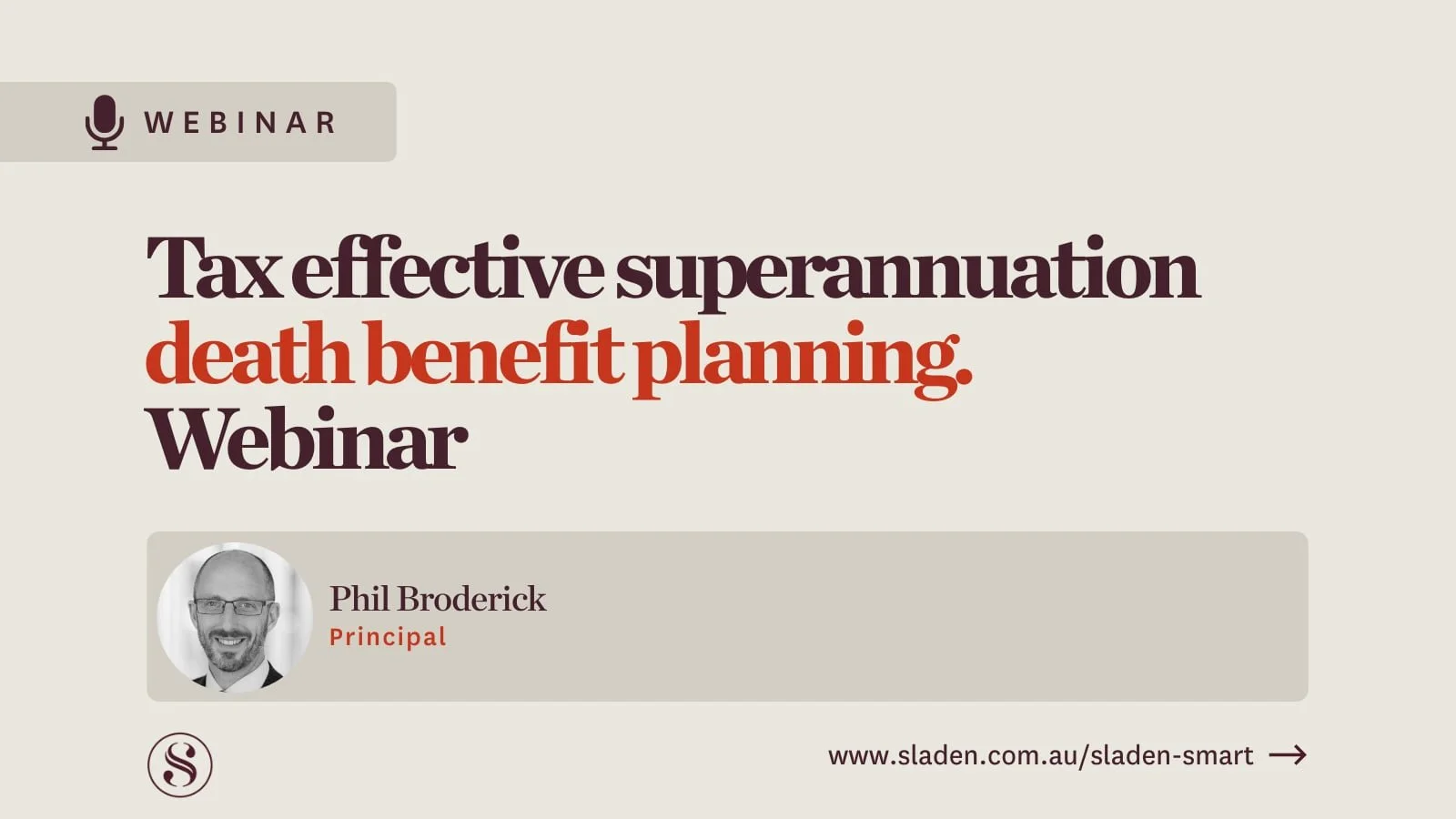
This session will examine potential strategies and planning in relation to dealing with death benefits from a tax perspective, including:
Recontribution strategies
Withdrawing benefits prior to death
Issues with death benefit lump sums of in-specie transfers of specific assets
Disclaiming death benefits
Deeds of family arrangements
Death benefits direct to beneficiaries versus testamentary trusts; and
When to use a superannuation proceeds trusts.
Family trust elections offer considerable benefits to family groups. However, the consequences for getting it wrong – family trust distribution tax at 47% plus the general interest charge – are dire. Adding to the mix is that family trust elections are an area of ATO focus.
This session will work through some of the key issues around FTEs (and IEEs) including:
When and how to make FTEs and IEEs
Groups with more than one test individual
Deaths and relationship breakdowns
Sales of businesses (or entities) in whole or part
Strategies when a liability for family trust distribution tax arises.
In this webinar we will delve into the intricacies of Family Trust Elections (FTEs). Through the exploration of real-life case studies, we'll uncover practical tips and potential pitfalls associated with both making and managing FTEs. Our discussion will cover:
Understanding the motivations behind opting for an FTE and scenarios that may lead trustees to reassess their decisions.
Examination of FTE-related issues as identified by the Australian Taxation Office (ATO) during their reviews.
Clarification on the necessity of an Interposed Entity Election (IEE) for receiving trust distributions without triggering Family Trust Distribution Tax (FTDT).
Discussion on the flexibility to revoke an FTE when its original purpose becomes irrelevant and adapting to evolving circumstances.
Assessment of the impact of a test individual's demise on a FTE.
Evaluation of potential implications for the sale of entities subject to FTEs or IEEs.
Exploration of inadvertent triggers of FTDT and potential avenues for reversal.
No results match your search. Try removing a few filters.