This webinar reviews Justice Lee’s Federal Court decision and draws out the matters executives and directors need to consider when performing their respective roles.

An estate plan often sets out to treat the beneficiaries on equal terms. However, it may not be until the estate is being administered that tax rears its head in some form so that one beneficiary’s share is diminished by the potential tax consequences attached to a certain asset, including superannuation.
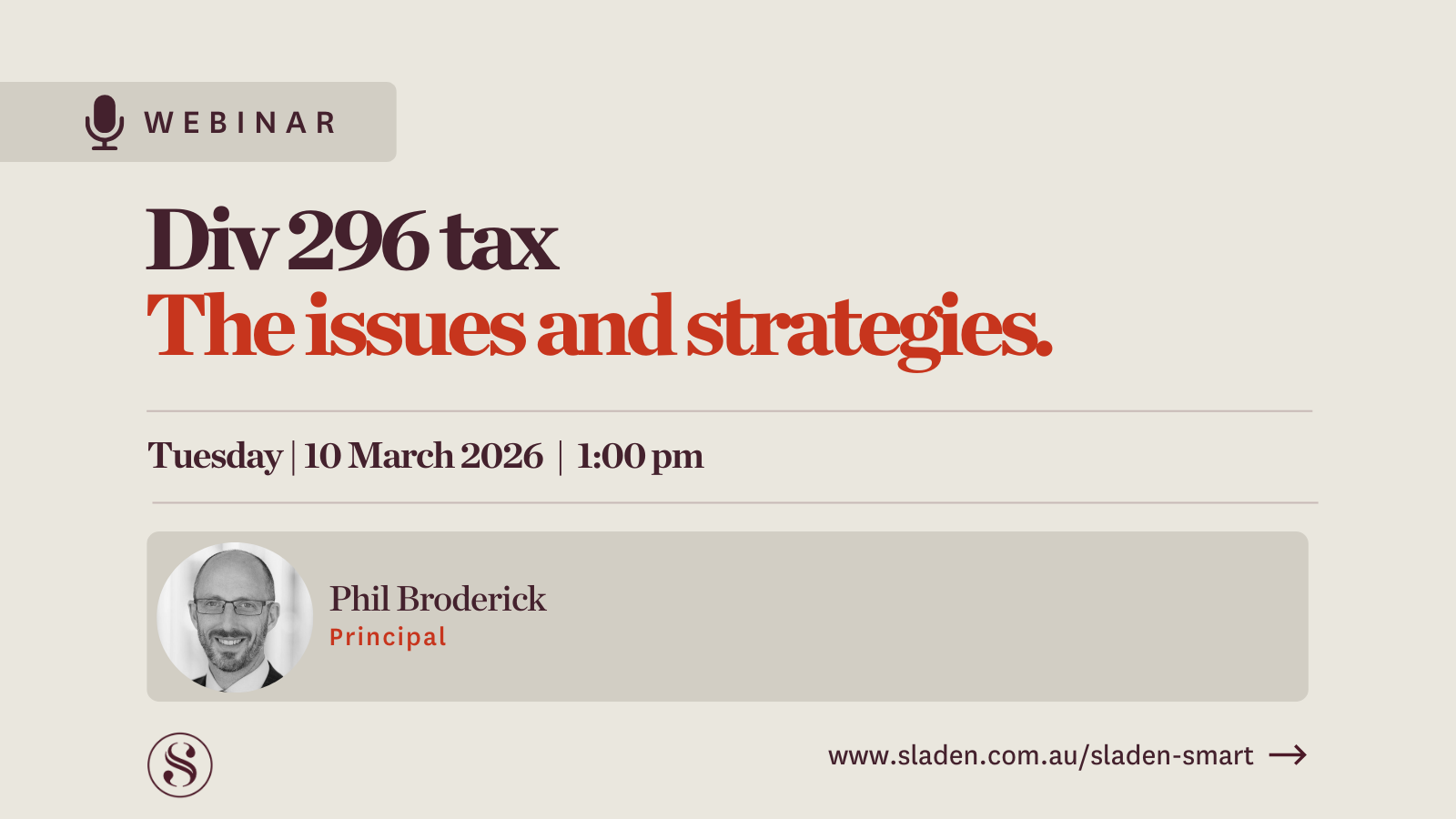
In this session, Phil will examine the issues and potential strategies in relation to the new superannuation Div 296 tax, including what (if anything) may be done before 1 July 2026 and 1 July 2027. This topic will include
The new Div 296 tax
Critical elements
The transitional rules
Problems in relation to indirect assets
Div 296 and death
This session will examine potential strategies and planning in relation to dealing with death benefits from a tax perspective, including:
Recontribution strategies
Withdrawing benefits prior to death
Issues with death benefit lump sums of in-specie transfers of specific assets
Disclaiming death benefits
Deeds of family arrangements
Death benefits direct to beneficiaries versus testamentary trusts; and
When to use a superannuation proceeds trusts.
Family trust elections offer considerable benefits to family groups. However, the consequences for getting it wrong – family trust distribution tax at 47% plus the general interest charge – are dire. Adding to the mix is that family trust elections are an area of ATO focus.
This session will work through some of the key issues around FTEs (and IEEs) including:
When and how to make FTEs and IEEs
Groups with more than one test individual
Deaths and relationship breakdowns
Sales of businesses (or entities) in whole or part
Strategies when a liability for family trust distribution tax arises.
This session will cover:
Principles required to establish an oppressive conduct claim
Types of relief available where oppressive conduct is found
Case examples demonstrating what conduct needs to be established in order for relief to be available
What will not amount to oppressive conduct.
Family-owned businesses and investment structures often hold significant wealth but much of it remains "locked" for reasons of tax efficiency, asset protection, or the need to retain control. This session explores how families can both unlock wealth when needed and establish enduring mechanisms for multi-generational wealth stewardship.
We’ll look beyond immediate liquidation strategies and show how unlocking wealth can involve careful planning, structured processes, and governance frameworks. From dividends and asset transfers to long-term control mechanisms such as wills, memoranda of wishes, successor appointments, and governance terms embedded in Constitutions. We’ll provide a clear roadmap for both wealth extraction and wealth preservation.
Key legal and tax considerations will also be covered, including trustee decision-making duties, related-party benefit provisions, and the role of a corporate appointor. We will explore succession and exit planning tools, CGT implications for renouncing interests, and critical anti-avoidance rules.
Through practical insights and case studies, participants will gain strategies for navigating complex family dynamics, balancing control with flexibility, and ensuring long-term protection of wealth.
Whilst the income tax is often front of mind, when it comes to small-scale property developments, GST should not be overlooked.
This session explores how GST can impact on such projects, including:
A review of recent ATO guidance and views
Distinguishing between commercial and private arrangements
The GST issues to consider for a property purchase, renovation, and then sale
Two new townhouses – live in one, rent one, how does the GST work?
How do property sale proceeds impact on the GST turnover test when determining if GST registration is required?
Can the margin scheme be useful for small- scale developments?
This session will examine the common issues that present when controllers of trusts lose capacity, including:
considering the circumstances in which an attorney or other person can step into the shoes of a trustee, appointor or guardian;
how to plan for such events; and
practical tips on conditions, limitations and instructions.
This session will cover:
What is a safe harbour for directors?
When will it be accessible to directors looking to take advantage of it?
What will it protect a director from?
How do you maintain the protection of safe harbour?
Case example demonstrating its application by the courts.
Unpacking the Past, Present, and Future of UPEs
The Full Federal Court’s decision in Commissioner of Taxation v Bendel (February 19, 2025) has redefined the tax landscape for trusts, ruling that unpaid present entitlements (UPEs) between a corporate beneficiary and a trust do not constitute a loan under s109D(3) of Division 7A. This outcome overturns years of ATO guidance and necessitates a reassessment of trust distributions and tax compliance obligations.
The ATO, on 18 March 2025, lodged an application for special leave to appeal to the High Court, and on 19 March 2025, issued an interim decision impact statement on the Full Federal Court decision, adding further uncertainty in the coming months for advisors.
This session will give advisors an update on this changing landscape and consider the practical considerations for practitioners managing trust structures during the current lodgement season and beyond.
Sometimes relationships don’t always work out. The appeal of operating a business in a trust and the prospect of the CGT discount may no longer outweigh the challenges of managing unpaid present entitlements and preparing annual distribution minutes.
But it’s not too late to rebuild. By restructuring from a trust to a company, you may be able mend those fractures, restore clarity, and create a stronger, more resilient business for the future.
In this presentation, Edward will outline some of the choices available under the income tax laws to restructure a business tax effectively from a trust to a company (e.g. CGT rollovers and the small business CGT concessions) and the tips/traps of which to be aware.
Not all relationships have to end in doom and gloom. Let’s repair and revitalize this important relationship—before it’s too late.
It seems that all investment structures are being attacked by Government and Revenue Authorities these days. SMSFs with restrictions on contributions and pensions, additional taxes and the non-arm’s length income rules. While trusts and companies are targeted with Division 7A and other measures.
This session will examine the benefits and limitations of each investment vehicle. This will include identifying opportunities, assessing risks, and understanding how alternative structures can complement each other for wealth creation, tax optimisation, and intergenerational planning.
This year’s Federal Budget is a few weeks before the Federal election. As Forest Gump said, “Life is like a box of chocolates. You never know what you're gonna get”.
In this free webinar you will hear Sladen Legal’s tax and superannuation team discuss and distil the key “chocolates” the morning after the 2025-2026 Federal Budget is released.
The webinar will focus on announcements that impact individuals, small businesses, family groups, and high-net-wealth clients.
In this webinar we will delve into the intricacies of Family Trust Elections (FTEs). Through the exploration of real-life case studies, we'll uncover practical tips and potential pitfalls associated with both making and managing FTEs. Our discussion will cover:
Understanding the motivations behind opting for an FTE and scenarios that may lead trustees to reassess their decisions.
Examination of FTE-related issues as identified by the Australian Taxation Office (ATO) during their reviews.
Clarification on the necessity of an Interposed Entity Election (IEE) for receiving trust distributions without triggering Family Trust Distribution Tax (FTDT).
Discussion on the flexibility to revoke an FTE when its original purpose becomes irrelevant and adapting to evolving circumstances.
Assessment of the impact of a test individual's demise on a FTE.
Evaluation of potential implications for the sale of entities subject to FTEs or IEEs.
Exploration of inadvertent triggers of FTDT and potential avenues for reversal.
During the stages of administration of a deceased estate, a beneficiary may become presently entitled to the income. It is important to recognize this to determine who is responsible for the payment of income tax on that income. This session covers the various stages of administration, including:
Can a beneficiary be presently entitled to estate income prior to the estate being fully administered?
What if payments of income are paid to the beneficiaries whilst the estate is in administration?
When is a deceased estate fully administered?
Does the estate have to be wound up for beneficiaries to be presently entitled to the income?
How is the income of a deceased estate taxed in the financial year it is fully administered (IT 2622)?
Deceased estates and CGT assets (TR 2004/D25):
- When does a beneficiary have absolute entitlement?
- CGT event E5 and the Division 128 exclusion
- The fungible asset test
- Worked examples
The taxing of a deceased estate:
- For the first three income years after death
- More than three years after death
No results match your search. Try removing a few filters.